


While the concept of gentle parenting has been making the rounds, we’re here to shed light on another approach that combines empathy and structure—authoritative parenting.
What is authoritative parenting?
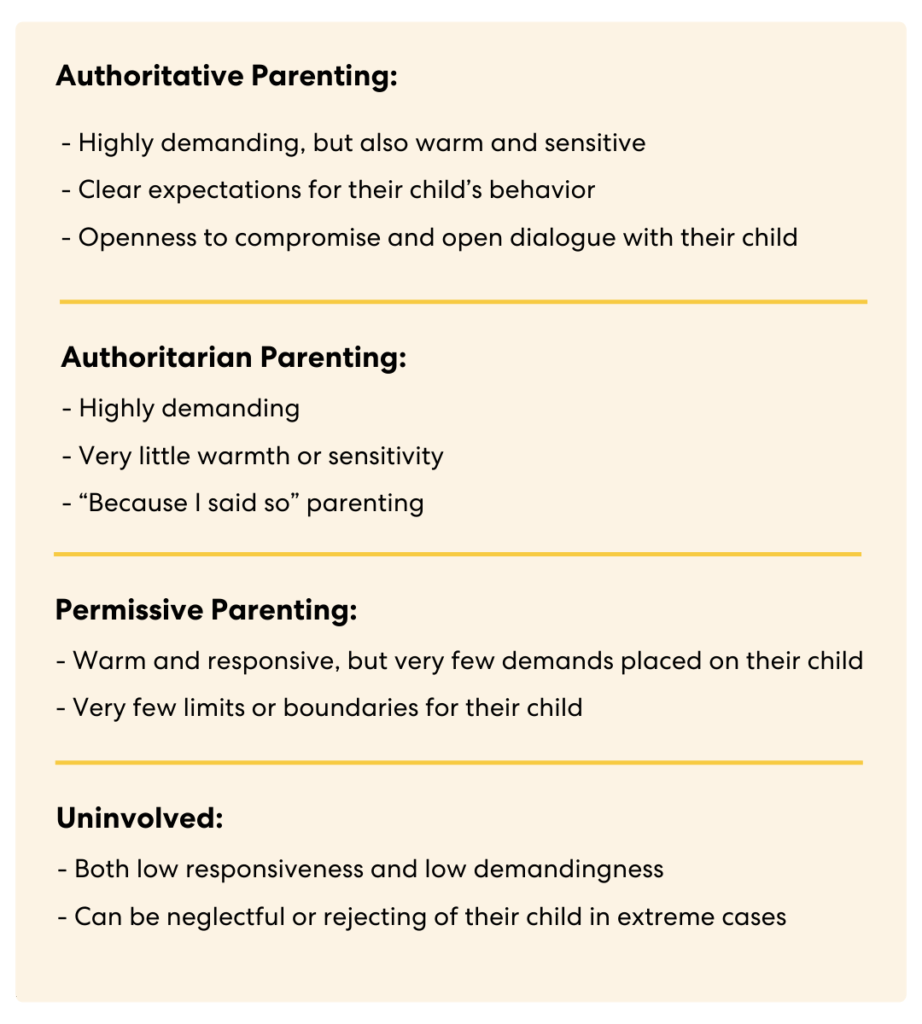
Authoritative parenting acknowledges the importance of firm limits balanced with warmth and sensitivity. It is one of four core parenting styles, originating with research conducted by renowned psychologist Diana Baumrind in the 1960s. Research has consistently found that authoritative parenting is linked to the most positive outcomes for children, including stronger academic and social-emotional skills. Here are the four parenting styles she observed:
See How Cooper Can Support You
What is Gentle Parenting?
Gentle parenting is an approach to raising children that prioritizes empathy, validation, and respect in parent-child interactions. It emphasizes nurturing a strong, emotional connection with children, providing positive reinforcement, and discipline rather than punishment.
While there’s absolutely nothing inherently wrong with gentle parenting, the movement has created PRESSURE. Pressure on you as a parent to adhere to scripts. To acknowledge your child’s feelings on a loop. To avoid setting firm boundaries and limits, that would actually benefit your child.
So that brings us to the 5 reasons why we recommend you refocus your energy on being an authoritative parent instead of a gentle parent:
1. Liberate yourself from parenting guilt.
While gentle parenting is well-intentioned, the constant pressure to follow its principles and “parent the right way” can lead to feelings of guilt, shame, and confusion. Authoritative parenting offers a more balanced and pragmatic alternative.
2. Drop the hyper-focus on feelings. Your relationship is resilient.
While gentle parenting intersects with the sensitivity and connection side of authoritative parenting, it is often used to justify languishing in a child’s feelings without the necessary guardrails and limits that research shows help children regulate and organize themselves. You can stop repeating “I know you feel sad” over and over and never making it out the door to school. You can stop worrying that you will do irreparable harm if you sometimes need to pick your toddler up and get to daycare or hold a boundary or limit that causes distress.
3. Backed by research for the best outcomes for your child.
Time and time again, authoritative parenting consistently emerges as the parenting style that’s most conducive to positive child outcomes, from academics to social-emotional skills. It gets there by integrating high expectations with warmth, clear boundaries, and open communication.
4. Limits provide children with a sense of safety and security through structure.
Limits give your child guardrails that help them understand and learn behavior. How you choose to establish and reinforce these is personal to your family, but for all of us, establishing limits is one of your most important responsibilities as a parent. By setting limits, you show your child that you want to protect them and that you are willing to tolerate their discomfort if it means they will benefit in the long run. Having limits shows that you are parenting for the long haul, not for the easy moment. Reasonable limits (like no throwing or adhering to a bedtime) help children understand what behavior is acceptable. This allows them to regulate themselves to a “standard,” and toward clear expectations.
5. Authoritative parenting honors how hard it is for you to stay calm in the face of your child’s highly reactive and frustrating behavior.
Maintaining that syrupy-perfect therapist voice you hear in Instagram reels isn’t realistic when you’re running on three hours of sleep and haven’t had a moment to yourself in… how long has it been?! Authoritative parenting gives you room to breathe by normalizing “good enough” parenting.
What Authoritative Parenting Looks Like in Real Life
Address and acknowledge your child’s feelings ONCE, offering a statement like, “I understand you’re enjoying the party, but it’s time to leave. Leaving can be tough, but we can handle challenges.”
Redirect their focus to the next activity: “Do you want to stomp like a dinosaur, or should I carry you?” If they’re not having it and you yell, it’s okay – we all do. Take a moment to repair: “I’m sorry I raised my voice when I got upset. Sometimes that happens when I’m frustrated, but next time I’ll try and say it differently.”
For older children, validate their emotions and stand firm on decisions, saying, “I understand how angry you feel that I won’t let you do that. It’s OK to be angry at me, but I’m not changing my mind. When you’re ready, I’m here to talk.”
In a Coop Group, we learn, strive for balance, and support one another through the diverse spectrum of parenting experiences – zero judgment, shame, or any pursuit of perfection – finding a parenting approach that resonates with each of us.
Still not sure how to put this into practice? Speak to a Cooper Expert